How to Find the Right Private School Near You in South Africa


Ranking the best schools in South Africa is not straightforward. Here is a practical checklist parents can use to judge quality for themselves.
Search for the best schools in South Africa, and you will find dozens of lists and rankings. Many of them rely on incomplete or outdated criteria. League tables based only on matric results tell parents very little. They say nothing about whether a school suits your own child, especially in the early years when foundations matter most. A more useful approach is to judge schools against a consistent, practical checklist.
This guide sets out what actually sets apart the best schools in South Africa. It looks at the factors that matter most to outcomes: teaching quality, class size, curriculum depth, and how a school supports scholars who are struggling or excelling.
Matric pass rates are the most common metric. Yet they say almost nothing about a school's foundation phase, its class sizes, or how it supports a child in the years before matric. In fact, a school can post excellent matric results while quietly losing learners who struggle earlier on. Strong schools, by contrast, show consistent quality from Grade R through to Grade 12.
Therefore, parents comparing the best schools in South Africa should ask for evidence across every phase. Do not just look at the final exam year.
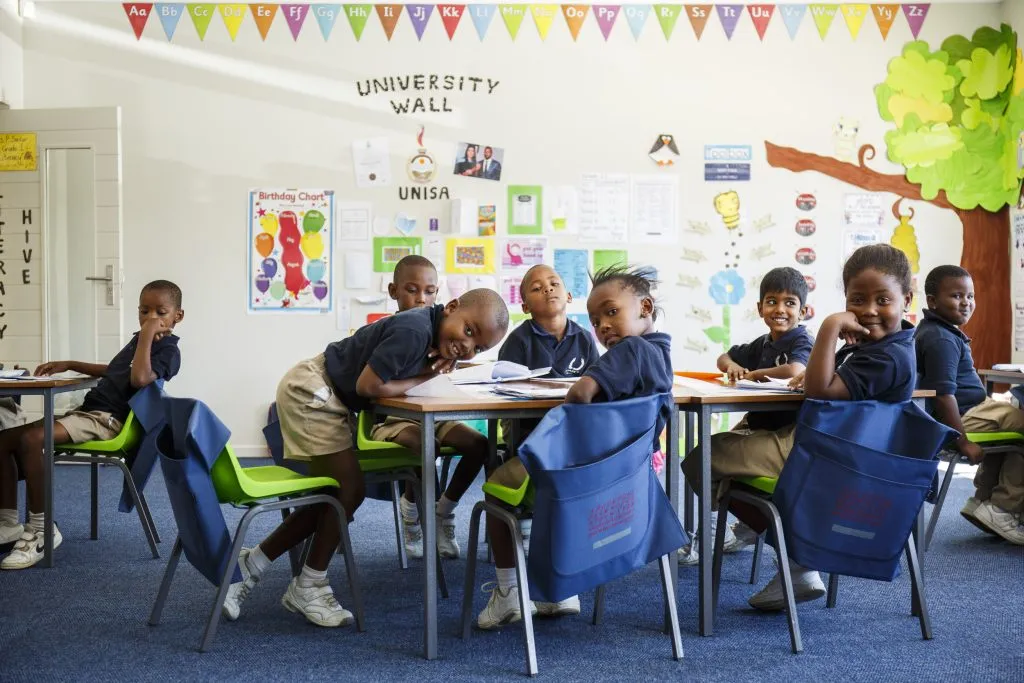
Class size is one of the clearest, most checkable signs of quality. Ask directly how many scholars sit in a classroom. Then ask how the school ensures each child gets real individual attention within that group. SPARK Schools, for example, caps grades at no more than 32 scholars. At the same time, it uses a blended, personalised learning model. This ensures each scholar still gets targeted academic support, rather than relying on class size alone.
The best schools in South Africa tend to combine local curriculum rules with internationally benchmarked standards. They do not simply teach to the minimum. SPARK Schools, for instance, uses Scholastic PRIME mathematics, benchmarked against Singapore, Korea, and Hong Kong standards. It also follows British literacy standards, alongside structured Social Emotional Learning. Together, this signals a school building for real academic depth, not just surface-level compliance.
Cost is unavoidably part of the conversation. According to ISASA, South Africa's independent schooling sector now serves more than 210,000 pupils across over 900 member schools. Fees span a huge range. However, the best schools in South Africa are not always the most expensive ones. Increasingly, affordable private networks match or beat the outcomes of far pricier institutions. They do this by focusing spend on teaching quality rather than facilities alone.
A short, direct list of questions can reveal more in twenty minutes than any brochure. First, what data does the school track on each scholar's progress, and how often? Second, what happens when a child falls behind, specifically? Third, how are teachers trained, and how often? Fourth, what extracurricular and social-emotional support exists beyond academics? Finally, what are the honest average class sizes, not the marketing figure?
SPARK Schools hosts regular open days across its 26 campuses. This gives parents the chance to ask these questions directly of school leaders and current teachers.
Where a school belongs to a larger network, consistency between campuses is worth checking closely. A single excellent principal can make one branch shine while others lag behind. So, ask how training, curriculum, and quality checks are standardised across every campus, not just the one closest to home.
SPARK Schools continues to expand into new communities across Gauteng and the Western Cape each year. As a result, families in growing suburban areas increasingly have a genuine quality option nearby, rather than a long commute to reach a strong school. Indeed, this expansion itself is a useful signal. Schools confident in their model tend to grow deliberately, repeating what already works rather than diluting it.
Ultimately, identifying the best schools in South Africa for your own family comes down to matching a school's model to your child's needs and your budget. Back this up with direct evidence, not reputation alone. Visit more than one option, ask the uncomfortable questions, and trust what you observe over what you are told.
If you would like to see how SPARK Schools measures up against this checklist, our team welcomes you to visit an open day. Alternatively, you can apply today to start the conversation about your child's place in 2026 or 2027.